The Law of Similars, discovered by Samuel Hahnemann, forms the foundation of homeopathic medicine. This principle states that a substance capable of producing symptoms in a healthy person can cure similar symptoms in a sick person when given in minute doses.
Historical Discovery
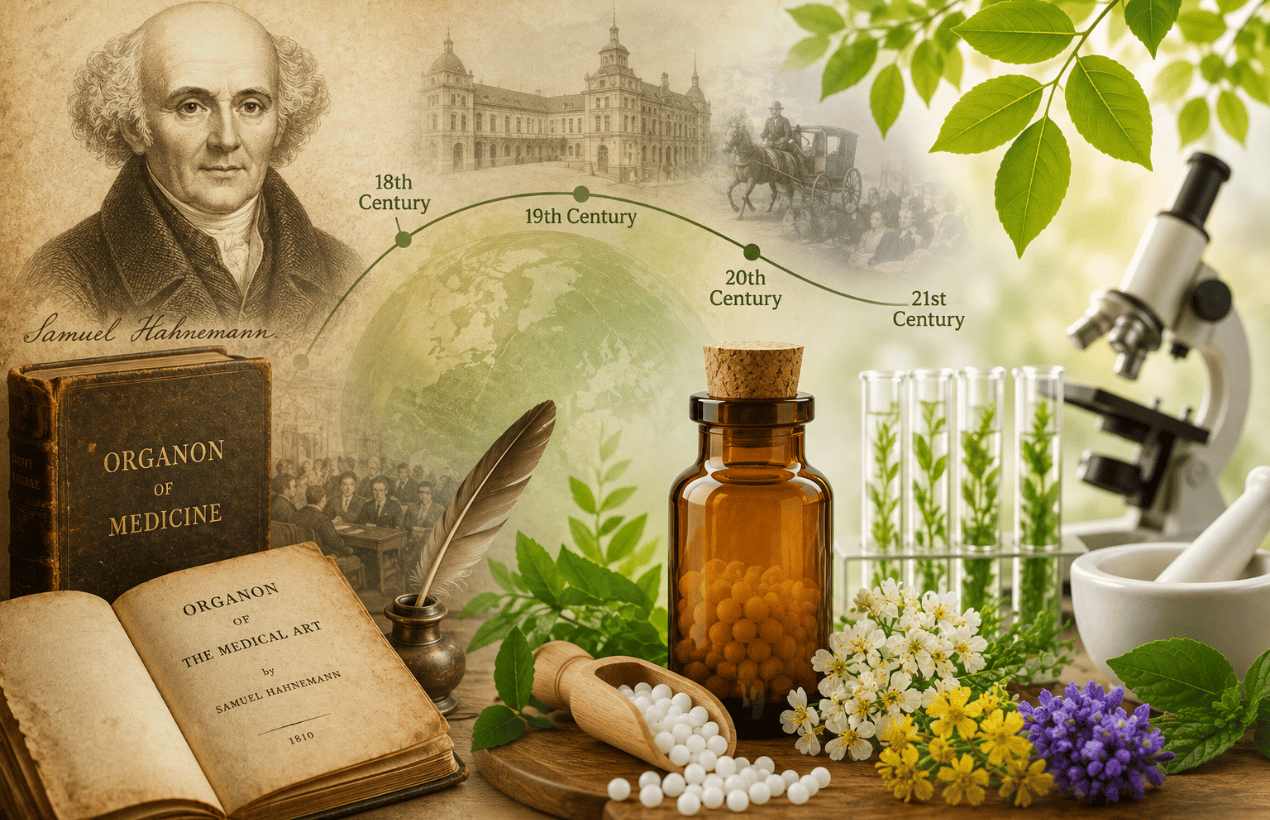
Dr. Samuel Hahnemann discovered this principle in 1790 while translating a medical text about cinchona bark (used for malaria). Intrigued by the explanation of how cinchona worked, he decided to test it on himself:
– He took repeated doses of cinchona bark
– Developed symptoms similar to malaria
– Realized the connection between the bark’s effects and its curative properties
– Formulated the Law of Similars: “Similia Similibus Curentur”
The Scientific Basis
Proving Process:
Homeopathic remedies are tested through “provings” – systematic trials where:
– Healthy volunteers take repeated doses of a substance
– All physical, mental, and emotional symptoms are recorded
– A complete symptom picture is developed
– This becomes the remedy’s therapeutic profile
Matching Process:
When treating illness:
– Patient’s complete symptom picture is taken
– The remedy whose proving symptoms most closely match is selected
– The principle of similarity guides the selection
– Like cures like in therapeutic application
Examples in Practice
Allium Cepa (Red Onion):
Proving symptoms: Burning, watery eyes and nose, just like cutting onions
Therapeutic use: Hay fever with burning, watery discharges
Arsenicum Album (Arsenic):
Proving symptoms: Burning pains, restlessness, weakness, digestive upset
Therapeutic use: Food poisoning, anxiety disorders, burning skin conditions
Belladonna (Deadly Nightshade):
Proving symptoms: Sudden onset, high fever, red flushed face, dilated pupils
Therapeutic use: Acute fevers, headaches, inflammatory conditions
Coffee Cruda (Coffee):
Proving symptoms: Sleeplessness, mental excitement, hypersensitivity
Therapeutic use: Insomnia, mental hyperactivity, oversensitivity to stimuli
Modern Understanding
The Law of Similars works through several mechanisms:
Hormesis Effect:
– Small doses of toxic substances can stimulate healing
– Similar to vaccines stimulating immunity
– Body’s adaptive response to mild stressors
Resonance Principle:
– Like frequencies resonate and cancel each other
– Similar symptom patterns neutralize disease patterns
– Energetic matching at vibrational level
Immune Modulation:
– Similars stimulate the body’s self-healing mechanisms
– Activate natural defense systems
– Restore balance rather than suppress symptoms
Clinical Applications
Acute Conditions:
– Rapid remedy selection based on prominent symptoms
– High potencies for intense, sudden onset conditions
– Frequent repetition until improvement begins
Chronic Conditions:
– Constitutional prescribing based on totality of symptoms
– Lower potencies given less frequently
– Long-term treatment addressing root causes
Mental/Emotional States:
– Remedies matching psychological symptom pictures
– Deep-acting constitutional remedies
– Integration of mind-body symptom patterns
Verification Methods
The Law of Similars is verified through:
Clinical Outcomes:
– Consistent therapeutic results across practitioners
– Reproducible effects in similar cases
– Long-term health improvements
Re-proving Studies:
– Modern verification of classical provings
– Double-blind proving trials
– Confirmation of original symptom pictures
Toxicology Correlation:
– Poison symptoms match therapeutic indications
– Substance effects correspond to healing properties
– Scientific validation through adverse effect studies
Practical Guidelines
For Practitioners:
– Detailed case taking to identify symptom totality
– Careful remedy selection based on similarity
– Appropriate potency and dosage selection
– Monitoring and adjusting based on response
For Patients:
– Provide complete, honest symptom description
– Trust the process of similar healing similar
– Allow time for natural healing to occur
– Avoid suppressive treatments when possible
The Law of Similars remains the cornerstone of homeopathic practice, offering a rational and natural approach to healing that works with the body’s innate wisdom rather than against it.