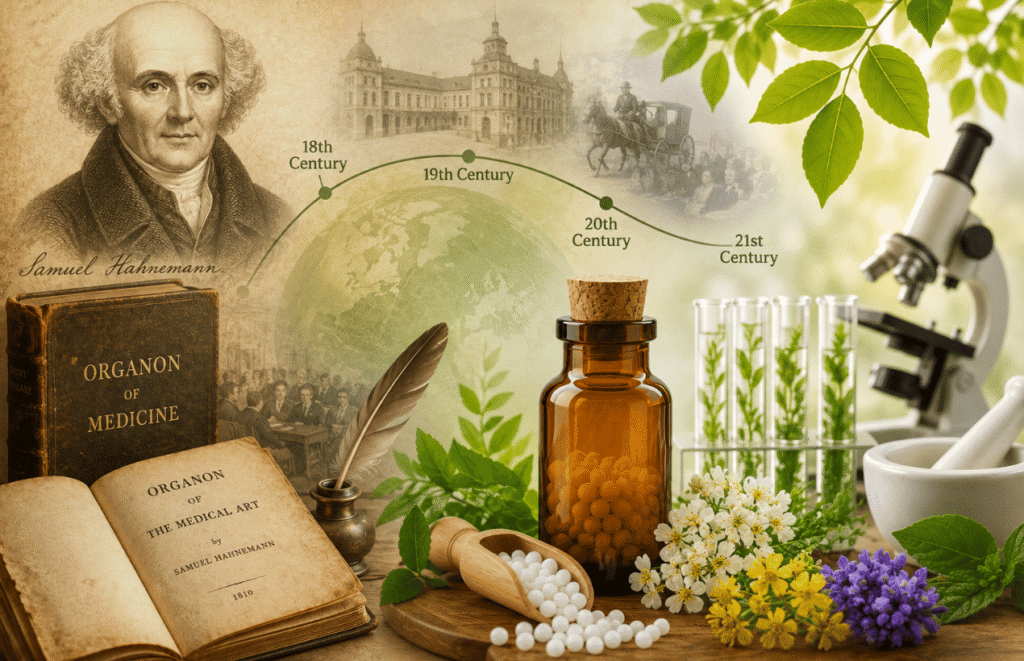
Homeopathy has stood the test of time as one of the world’s most widely recognized complementary systems of medicine. Since its introduction over two centuries ago, it has evolved from a groundbreaking medical concept into a globally practiced healthcare discipline that emphasizes individualized, holistic care.
Founded on the belief that every patient is unique, homeopathy continues to be chosen by millions of people seeking a personalized approach to health and well-being. While healthcare has advanced significantly over the centuries, the core principles of homeopathy have remained remarkably consistent, focusing on treating the individual rather than merely addressing the disease.
This blog explores the fascinating journey of homeopathy—from its origins in eighteenth-century Germany to its place in modern healthcare today.
The Origins of Homeopathy
The story of homeopathy began in 1796 with Dr. Samuel Hahnemann (1755–1843), a German physician, chemist, and linguist. During his time, conventional medical practices often involved treatments such as bloodletting and the use of harsh medicinal substances, many of which produced significant side effects.
Seeking a safer and more rational method of healing, Dr. Hahnemann questioned existing medical theories and conducted his own observations and experiments.
While translating a medical text written by the Scottish physician William Cullen, Hahnemann became interested in the medicinal effects of cinchona bark, which was widely used to treat malaria. To understand its action, he consumed the bark himself while he was healthy. He observed that it produced symptoms similar to those experienced by individuals suffering from malaria. Once he stopped taking the bark, the symptoms disappeared.
This observation inspired one of the most fundamental principles of homeopathy:
“Similia Similibus Curentur” — “Like Cures Like.”
This principle suggests that a substance capable of producing certain symptoms in a healthy person may, when specially prepared and prescribed appropriately, be used to treat similar symptoms in someone who is ill.
The Development of Homeopathic Principles
Following years of careful clinical observation and research, Dr. Hahnemann developed a system of medicine based on several guiding principles.
These include:
- The Law of Similars (“Like Cures Like”)
- Individualized treatment for every patient
- Treating the person as a whole rather than focusing solely on the disease
- The use of carefully prepared medicines through potentization
- The principle of using the minimum effective dose
These concepts laid the foundation for homeopathic practice and continue to guide qualified homeopathic physicians around the world.
Homeopathy Spreads Across Europe
During the early nineteenth century, homeopathy gained popularity throughout Europe.
Countries including Germany, France, Austria, Italy, and the United Kingdom witnessed the establishment of homeopathic hospitals, pharmacies, medical societies, and educational institutions. Many physicians appreciated its patient-centred philosophy and individualized approach, contributing to its growing acceptance.
As awareness increased, homeopathy expanded beyond Europe and reached many other parts of the world.
Global Expansion of Homeopathy
By the mid-1800s, homeopathy had spread to North America, South America, Asia, and other regions.
Homeopathic medical colleges, hospitals, pharmacies, and research organizations were established, helping to strengthen education and professional practice.
Over the years, different countries developed their own regulatory systems governing the education and practice of homeopathy, reflecting local healthcare policies and standards.
Homeopathy in India
India has become one of the leading countries in the practice and education of homeopathy.
Introduced during the early nineteenth century, homeopathy gradually gained widespread acceptance among both healthcare professionals and the public. Today, India is home to numerous homeopathic medical colleges, hospitals, research institutes, and qualified practitioners.
The country also supports homeopathic education through structured academic programs and regulatory frameworks, ensuring professional standards in education and clinical practice.
Millions of people in India continue to seek homeopathic care for a wide variety of acute and chronic health concerns.
Homeopathy in the United Arab Emirates
In recent years, homeopathy has gained increasing recognition in the United Arab Emirates as part of the country’s growing interest in complementary and integrative healthcare.
Qualified homeopathic physicians practice within licensed healthcare facilities under the regulations established by the relevant health authorities. Patients seeking holistic healthcare now have greater access to professionally regulated homeopathic services alongside conventional medical care.
This reflects the UAE’s commitment to offering diverse healthcare options while maintaining high standards of patient safety and professional practice.
Homeopathy in the Modern Era
Modern homeopathy continues to emphasize individualized patient care.
Rather than focusing solely on a diagnosis, a homeopathic consultation involves understanding the patient’s complete health picture. This often includes:
- Presenting complaints
- Medical history
- Emotional well-being
- Sleep patterns
- Dietary habits
- Lifestyle factors
- Family history
- General health characteristics
This comprehensive assessment allows treatment plans to be tailored according to each individual’s unique needs.
Many patients choose homeopathy as part of an integrative healthcare approach, combining it with healthy lifestyle practices and, when appropriate, conventional medical care under professional guidance.
Education, Research, and Professional Practice
Today, homeopathy continues to be taught in recognized educational institutions in several countries.
Training typically includes subjects such as:
- Anatomy
- Physiology
- Pathology
- Clinical medicine
- Materia Medica
- Repertory
- Homeopathic philosophy
- Case-taking and clinical practice
Research into homeopathy also continues in universities, hospitals, and research institutions, contributing to ongoing scientific discussion and professional development.
The Holistic Philosophy of Homeopathy
One of the defining characteristics of homeopathy is its holistic philosophy.
Rather than viewing disease in isolation, homeopathy considers the patient as a whole person. Physical symptoms, emotional well-being, lifestyle, environmental influences, and individual characteristics are all taken into account during the consultation process.
This patient-centred approach recognizes that two individuals with the same medical condition may experience it differently and therefore may require individualized treatment plans.
Why Many People Choose Homeopathy
Patients often appreciate homeopathy for its personalized approach to healthcare.
Some commonly valued aspects include:
- Individualized consultations
- Holistic assessment of health
- Patient-centred care
- Consideration of both physical and emotional symptoms
- Focus on overall well-being
The choice of treatment should always be made in consultation with a qualified healthcare professional based on each individual’s medical needs.
Looking Toward the Future
As healthcare continues to evolve, patients increasingly seek approaches that combine scientific medical care with personalized attention and holistic support.
Homeopathy remains an established complementary system of medicine in many parts of the world. Its emphasis on individualized care, careful observation, and treating the whole person continues to make it a valuable option for many individuals seeking comprehensive healthcare.
Conclusion
From its beginnings in eighteenth-century Germany to its presence in modern healthcare systems around the world, homeopathy has undergone a remarkable evolution.
Although medicine has advanced considerably over the past two centuries, the principles introduced by Dr. Samuel Hahnemann continue to influence homeopathic practice today. By focusing on individualized care and the overall well-being of each patient, homeopathy remains an important part of complementary healthcare for many people worldwide.
Whether you are new to homeopathy or have previously experienced its holistic approach, understanding its rich history offers valuable insight into a system of medicine that has continued to evolve while remaining true to its foundational philosophy.
Discover the Benefits of Individualized Homeopathic Care
At our clinic, we believe that every patient deserves personalized attention and compassionate care. Our qualified homeopathic physician takes the time to understand your unique health concerns and develop a treatment plan tailored to your individual needs.
If you would like to learn more about homeopathy or schedule a consultation, contact our clinic today and take the first step toward a holistic approach to health and well-being.